It starts with a cry. It ends with no words. In between, it grows up in your hands.

Seed in the Wind

One book for a whole life, from the crib to the door. Book one of Life is Easy, Life is Hard, by Solomon Okonkwo.

Out November 17, 2026. Paperback and Kindle.

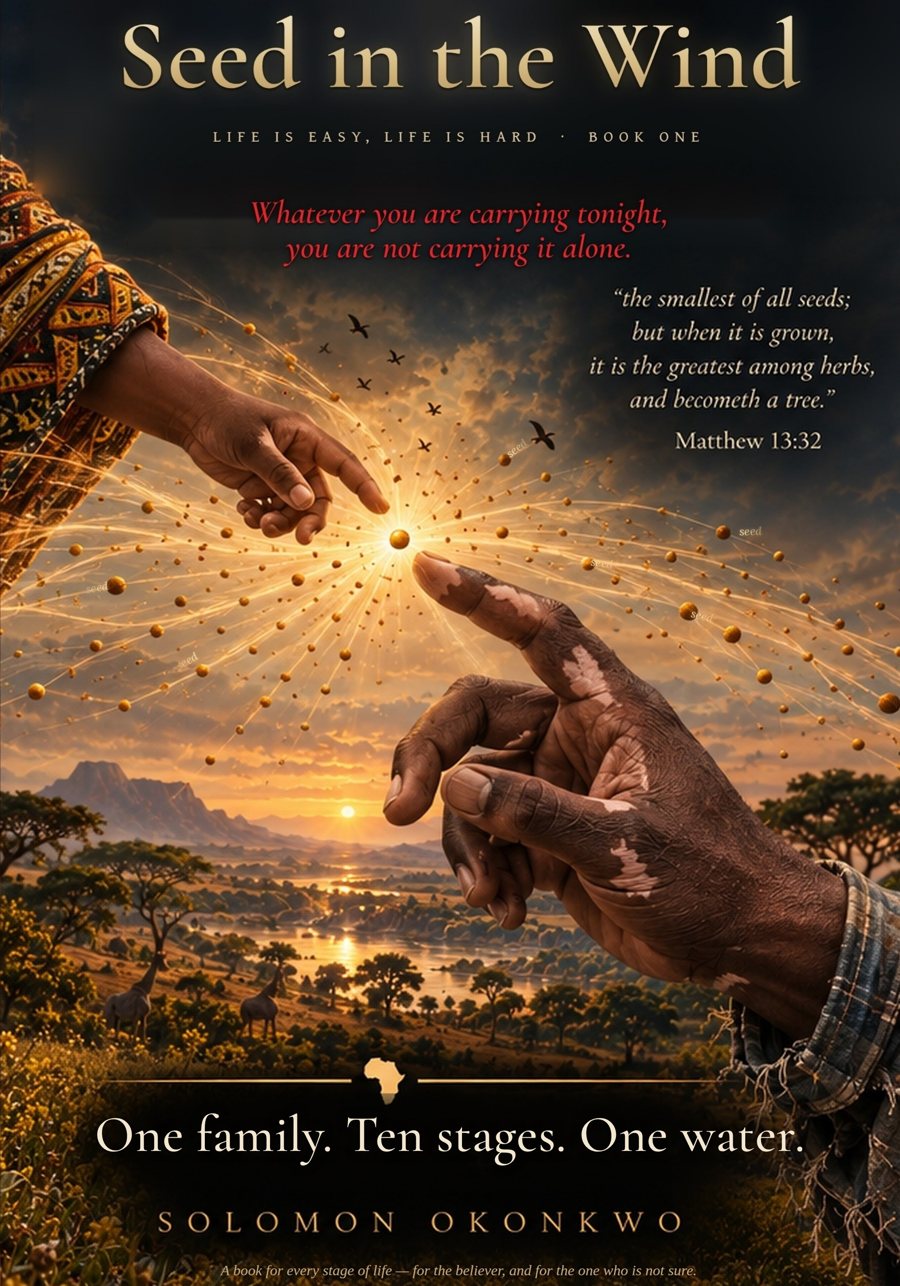
The cover of Seed in the Wind: two hands reaching toward a glowing seed over an African savanna at sunset.

Whatever you are carrying tonight, you are not carrying it alone.

What you feel makes sense. Nobody in these pages will tell you that you are wrong.

Something happens. There are two ways to go.

Every page is one moment in one family's life. The book shows both ways, a seed and a no-seed, and where each one leads. Here is one page from the Teen chapter.

When the son was seventeen he said the four words most teenagers say to a parent sooner or later, and he meant them.

u dont get it
u never will. ur from a different planet fr
Read 11:42 p.m.

If the father texts back a seed

youre right. i dont
tell me. i will shut up and listen. no fixing
11:44 p.m.

The son typed for six minutes. Three words. “You’re right. Tell me.” The hardest sentence a parent says.

If the father texts back no seed

11:42 p.m. Read. No reply. The son remembers that timestamp at 40.

What took the wheel: pride. Being right feels better than being told. It makes sense that it did. It just does not get to keep the wheel.

Whichever one was you tonight, it made sense from where you stood. Do not be afraid to live.
Ten stages, lit like one day.

The book follows a day: dawn for the baby, noon for the young adult, night for the last year, and dawn again. Open it to the stage you are standing in. Life skips stages; if yours skips a page, skip the page.

  1. 1

    Baby ages 0–2

    Three nights, for the parent. The baby cannot read. Your face is what it reads.

  2. 2

    Child ages 3–12

    Get low, at their height. Keep your word.

  3. 3

    Teen ages 13–17

    He texts at 11:42 p.m. You reply by 11:44. Fast, and a seed.

  4. 4

    Young adult ages 18–30

    Not choosing is a choice. Pick anyway.

  5. 5

    Marriage about 25–40

    Iron sharpens iron: two people make each other better, or one wears thin.

  6. 6

    Parent about 25–45

    Short dark pages for 3 a.m. Read with a baby in one arm.

  7. 7

    Middle ages 40–60

    The low years. Happiness dips near 47, then climbs back.

  8. 8

    Old 65 and over

    What counts now is people, not money.

  9. 9

    Death the last year

    One pick, not two: how you meet it, and nobody grades that.

  10. Then a letter, printed upside down, from whoever holds the book to whoever holds it next.
  11. 10

    Reunion after

    One door. No two ways this time.

Every stage ends on a tablet.

A reference from the Bible, handed from one child of God to another. Its Scripture is the Ethiopian Holy Bible. It does not tell you how to live. It shows two ways and where each one goes, with His words on every page.

Three lines from the Bible
Two in Christ’s own words, one from His apostles.
One line to say once a day
Out loud, until the next stage.
A sum you can check
On your fingers, at the kitchen table.
What the lab measured
With the source in the back, so you can see how many people were awake with you.
“What happens is not the path. What you do next is the path.”

The one rule, for the whole of a life.

About the author

Solomon Okonkwo is a U.S. Army veteran and a father. He wrote Seed in the Wind for his son, so that whatever stage of life the boy was standing in, someone would already be there, and the Word would already be on the page.

For the believer, and for the one who is not sure. Write to him at hello@seedinthewind.com. Every message is read.